Psyclone AIOS 2.3: a new PsyProbe, services for every device, native Windows, and crash-safe shared memory
Today we’re releasing Psyclone AIOS 2.3. 2.2 gave Psyclone builders, a supervisor and LLM connections. 2.3 is about the moment your system is actually running: you can see it, steer it, connect devices to it, and trust it to keep going when a component crashes. Here’s what’s new.
Meet PsyProbe 2.0 🔭
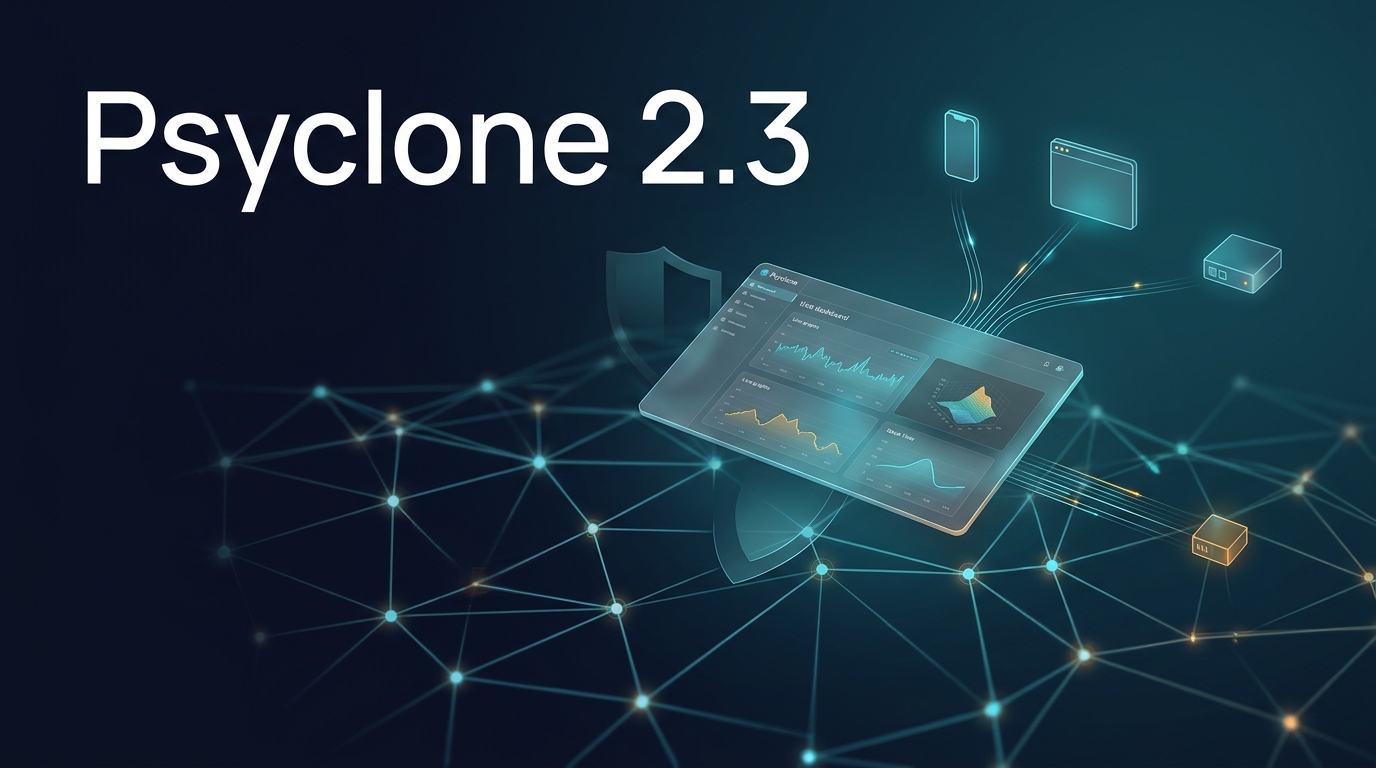
PsyProbe has been rebuilt from scratch, and it is now the home page of every Psyclone node. Start a system, open /v2/ in a browser, create the first admin account with the setup code Psyclone prints, and you’re looking at your system live.
- The live picture: every component, whiteboard and catalog, with ten minutes of history streaming over a WebSocket. Multi-node systems appear as one view, with a 3D view for the big picture.
- Control: stop, start or restart a component, edit its parameters (with the descriptions and units from your psySpec) and use the web console. Every action asks for confirmation first.
- Built for real deployments: accounts with roles, API keys and an audit log; HTTPS with a built-in local certificate authority or free ACME certificates; alerts, Prometheus
/metricsand secret masking. - Federation: several Psyclone systems can share one PsyProbe, with signed identity assertions and role caps.
- Make it yours: add your own applications and views with the view SDK. The full PsyProbe source (Svelte 5 + TypeScript) ships in the LGPL source distribution.
Services: connect phones, browsers and edge devices 🔌
Getting data into and out of a running system used to mean writing a bridge. In 2.3, you declare it in the psySpec instead:
- HTTP services: ingestion endpoints, request/reply with a timeout, and file hosting.
- WebSocket streams: an incoming frame becomes a post, and a trigger sends a frame out.
- UDP and TCP message services for lightweight devices.
Devices choose a post by name, never a raw message type, and a connection can only be used by the service that issued it. A new compact packed message format comes with a byte-exact Kotlin/Android codec, so an Android app can speak Psyclone’s own message format directly.
Native on Windows 🪟
The Windows x64 port is complete. All four configurations build with zero errors in Visual Studio 2022, and the test suites pass on Windows, including the browser end-to-end tests for single-node, multi-node and federated systems. SSL builds use OpenSSL 3.5.9 (LTS).
Shared memory that survives a crash 🛡️
Psyclone’s speed comes from shared memory between processes, and until now a process that crashed at the wrong moment could leave a lock held and stall a node. Not any more:
- Locks recover from a dead owner: if a process dies while holding a lock, the next one takes it over. Linux uses robust mutexes. macOS uses a new lock word, which turned out to be faster than the native mutex.
- No more wedged semaphores or events: they can no longer be left stuck by a process killed inside them.
- Shared names belong to their creator: a component that exits cleanly no longer takes the node’s shared memory with it.
On macOS, our external-executable stress test went from 2 passes in 20 to 40 out of 40.
And much more 🧩
- Ordered delivery: a process’s messages reach its cranks in queue order.
- Type wildcards: a trailing
*in a trigger type matches every deeper type. - One start signal:
Psyclone.Readyis sent exactly once. - Better Python: the binding returns dicts, handles binary data, and reads the packed format. Python cranks now run straight from the binary distributions.
- Networking: big WebSocket frames, multi-packet HTTP requests and better UDP handling.
- Fixes: 22 changelog Fix entries across Psyclone and CMSDK, many covering several bugs.
Tested where it runs ✅
Every distribution was unpacked fresh on its own platform, built where it’s a source distribution, and run through the built-in test suites from the unpacked files: – Linux, macOS (Apple Silicon) and Windows: all 70/70 CMSDK tests and the system test pass. – CMSDK on its own: passes 44/44.
Each distribution ships a new Psyclone 2.3 Quickstart and a Technical Whitepaper in Docs/.
Get it
Download the source and binary distributions for Linux, macOS and Windows. The documentation is at:
- Psyclone: psyclone.cmlabs.com
- CMSDK: cmsdk.cmlabs.com
We’d love to hear what you build with it.