Conversation is not ping-pong
People reply in about 200 ms, overlap constantly and steer the speaker while they listen. Part 2 of our series on Context Aware Turn Taking (CATT).

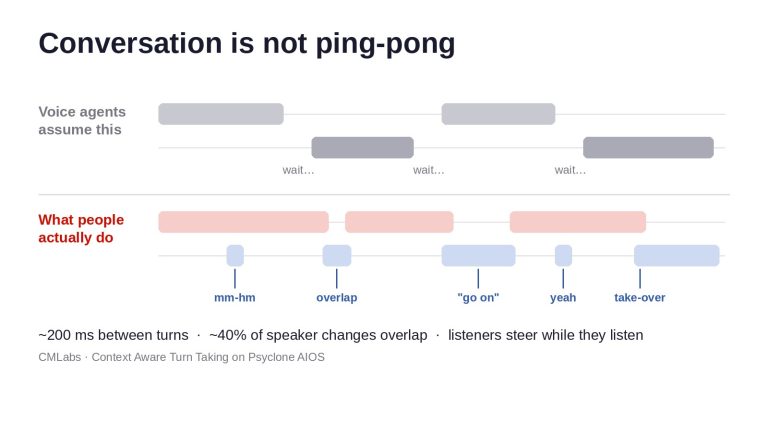
People reply in about 200 ms, overlap constantly and steer the speaker while they listen. Part 2 of our series on Context Aware Turn Taking (CATT).
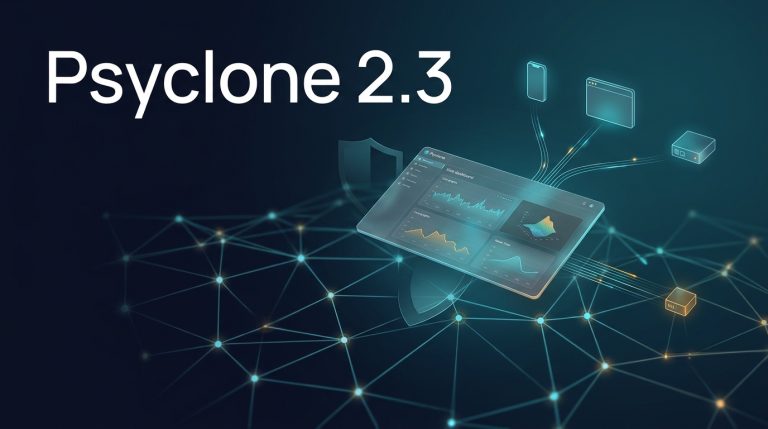
Psyclone AIOS 2.3 is out: PsyProbe 2.0 for monitoring and controlling live systems, HTTP/WebSocket/UDP services for phones and edge devices, native Windows x64, and shared memory that survives a crashed component.
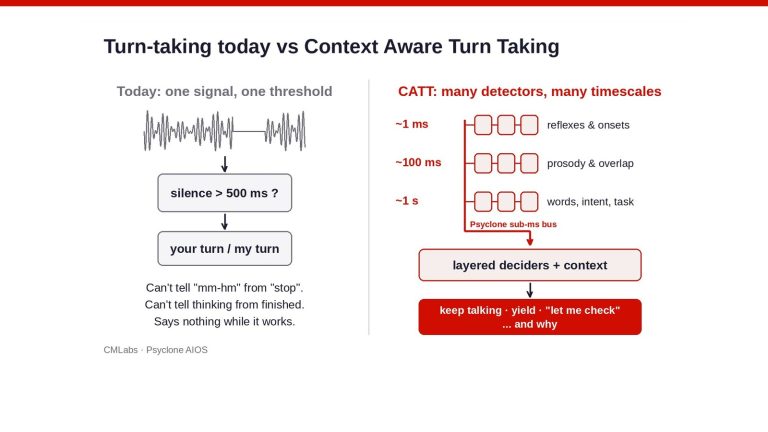
Most voice agents stop mid-answer when you say “mm-hm”, go silent during long tasks, and cut you off when you pause to think. Part 1 of our series on Context Aware Turn Taking (CATT).

Modern real-time systems increasingly need to talk to large language models — for reasoning, classification, generation or supervision. Psyclone 2.2.0 makes that a first-class capability with LLM Connections in CMSDK: a native connection primitive for calling language-model endpoints directly from your components. Declare it, don’t wire it A new <llm> / <llmvendor> primitive lets you…

Real-time systems live or die on how they start. Psyclone 2.2.0 introduces an automatic Startup Supervisor — a proper first-class citizen of the runtime that owns bring-up, watches the system, and gives you a single point of control over the whole lifecycle. A Root-space crank, not a special case The Supervisor now runs as a…
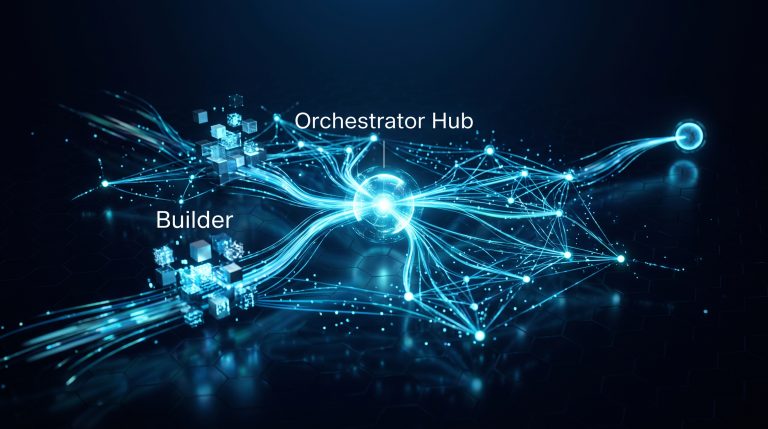
Bringing a distributed real-time system up used to be the quiet, fragile part of the job — a script here, a hope there, and no real visibility into what happened between “start” and “ready”. Psyclone 2.2.0 changes that with Builders: a first-class, observable pipeline for baking a system into existence. A Recipe with a real…

Earlier this year we shipped verified TLS/HTTPS support in CMSDK, with a network_https test performing a real handshake and encrypted round-trips over loopback using a runtime-generated certificate. That proved the transport worked. It did not, on its own, make it safe by default — and we said at the time that certificate-verification hardening was on…

Almost every real-time pipeline eventually needs to wait for a combination of things. Fuse three sensors before you act. Wait until both the transcript and the speaker ID have landed. Proceed once any two of five nodes report ready. Classic publish/subscribe gives you one trigger per message, so that logic has always ended up inside…

Real-time systems are rarely pure. Alongside your in-process Psyclone modules there is almost always a helper that has to live in its own process — a vendor SDK that insists on owning main(), a Python service, a camera daemon, a licensed binary you cannot link against. Until now, wiring those into a Psyclone node meant…
We’re excited to release Psyclone AIOS 2.1.1 — the most significant update to Psyclone since the 2.0 line. If you build real-time, distributed, publish/subscribe systems, this release makes Psyclone faster, more portable, and far easier to drive from the language you already use. Here’s what’s new since our last release (2.0.3). Psyclone now runs natively…