
Proven in the Field
Most AI platforms arrive with a pitch deck. Psyclone arrives with a deployment record. CMLabs has spent two decades building real-time distributed AI systems, and the architecture behind Sub-Millisecond AI has been through EU-funded robotics research, industrial deployments with major manufacturers, and live commercial production systems. “Sub-Millisecond AI” isn’t a fresh pivot — it’s a name for what Psyclone has already been proving in the field for years.
For technical readers, the short version: real-time multi-module coordination across mixed C++/Python systems, distributed pub/sub messaging under live-demo pressure, and hardware integration spanning robots, vision systems, and speech pipelines — all in settings where “it worked on my machine” was not an acceptable outcome.
Selected engagements
A cross-section of real systems built on the CMLabs stack — from humanoid robotics and self-programming AI research to production computer-vision and cloud platforms.
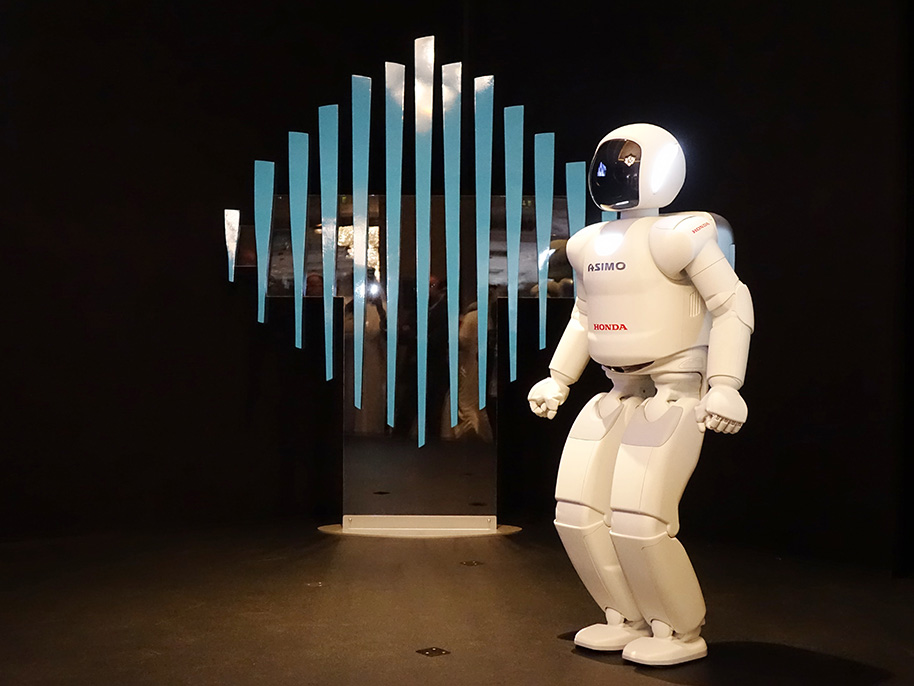
Honda Research Institute — Cognitive Architecture for the ASIMO Humanoid
CMLabs delivered core cognitive infrastructure for Honda Research Institute USA’s “Project Mentor” intelligent-robot architecture, built on Psyclone AIOS — across two multi-phase contracts, CogMap and MOVEIT. The Cognitive Map became the communication and memory backbone of the robot: a dual-memory architecture (State of the World / State of the Mind), publish/subscribe whiteboards as system-wide short-term memory, high-performance Indexers over continuous sensor streams, and fuzzy-logic Detectors and Deciders that turned raw streams into cognitive events. Detection logic was programmable at runtime — first in a Boolean condition language, then in full Lua scripting injected into the live system — with the entire multi-module architecture instantiated from a single XML specification and reconfigurable on the fly through hierarchical Contexts. The follow-on MOVEIT project added the AIRMan API: remote module control, live traffic statistics, record-and-playback of module communication for repeatable offline testing, crash detection with automatic restart, and full runtime introspection. Honda Research Institute took a signed site license for Psyclone AIOS.
HUMANOBS — Humanoids That Learn by Observation (EU FP7)
An EU FP7 research project (#231453) with a consortium led by Reykjavik University / CADIA, alongside CMLabs, UPM, CNR-ISTC, IDSIA and others. Its goal: an artificial agent that learns complex socio-communicative skills autonomously, purely by observing humans, with almost no hand-coded domain knowledge. The result was AERA — the first running system to demonstrate genuine cognitive growth: its evaluation agent learned to conduct a multimodal TV-style interview, taking either role, after simply watching two humans do it — learning in minutes, not days, on a single machine. CMLabs led Work Package 4, the Real-Time Experimental Platform, designing and building mBrane: a distributed, type-based publish/subscribe runtime engineered in C++ for raw performance (target: 100 modules exchanging 10 messages each within 10 milliseconds across networked machines). mBrane provided hierarchical context spaces, cluster-aware nodes with elected-reference clock synchronisation and automatic failover, pluggable network transports, and full live reconfigurability — the soft real-time nervous system on which the entire self-programming stack ran.
Edge-to-Cloud Facial Recognition Platform
A biometrics technology company needed a facial-recognition platform that could scale from a proof of concept to nationwide deployments — retail loss prevention across dozens of stores, and clinical workflow automation inside a public hospital. CMLabs designed the system architecture, built the core recognition server and gateway, and delivered every major evolution of the platform: cloud deployment, a REST API layer, mobile-triggered cross-device workflows, enterprise directory authentication, and integration of a dedicated hardware match-acceleration card. The architectural answer to the bandwidth problem — “video processing on the edge, images on the server” — became the foundation of the whole product line: a lightweight edge component detects faces on live video and sends only cropped images upstream, so the system deploys over ordinary public internet links. The multithreaded C++/Qt FaceServer runs recognition, alerting and testing on dedicated threads against a 30+ table relational schema, behind a pluggable recognition-engine abstraction that outlived any single vendor SDK. For a hospital deployment, CMLabs engineered a mobile-to-workstation clinical link and credential-free enterprise authentication that stores no passwords locally, and later integrated an associative-processing hardware accelerator as a modular coprocessing match engine.
My3GCam — Cloud Platform for Cellular-Connected Cameras
A complete cloud service for battery-powered surveillance cameras connected over 3G cellular networks — cameras placed anywhere with mobile coverage, with no Wi-Fi, no fixed IP, and no local infrastructure — built years before “IoT” was a buzzword. CMLabs built the full stack: a custom C++ CamServer gateway with a multi-listener architecture (plain and SSL/TLS camera listeners plus embedded HTTP/HTTPS servers exposing a REST-style API, no third-party web server required), a reverse-connection model for carrier-NAT traversal, an HTTP live-view API serving on-demand frames from cameras that were themselves unreachable, cellular-aware device telemetry (battery, signal, IMSI, cell ID), cell-tower geolocation, and data-quota management for metered connections with SMS/MMS notifications. Pluggable storage backends let the C++ gateway and a PHP/MySQL portal run on separate hosts and scale independently, and the whole thing was fronted by a desktop-class single-page web app with dockable layouts, camera walls and a live map — built on an RIA framework that pre-dated mainstream SPA frameworks.
CoCoMaps — human-robot collaboration, funded and scrutinised by the EU
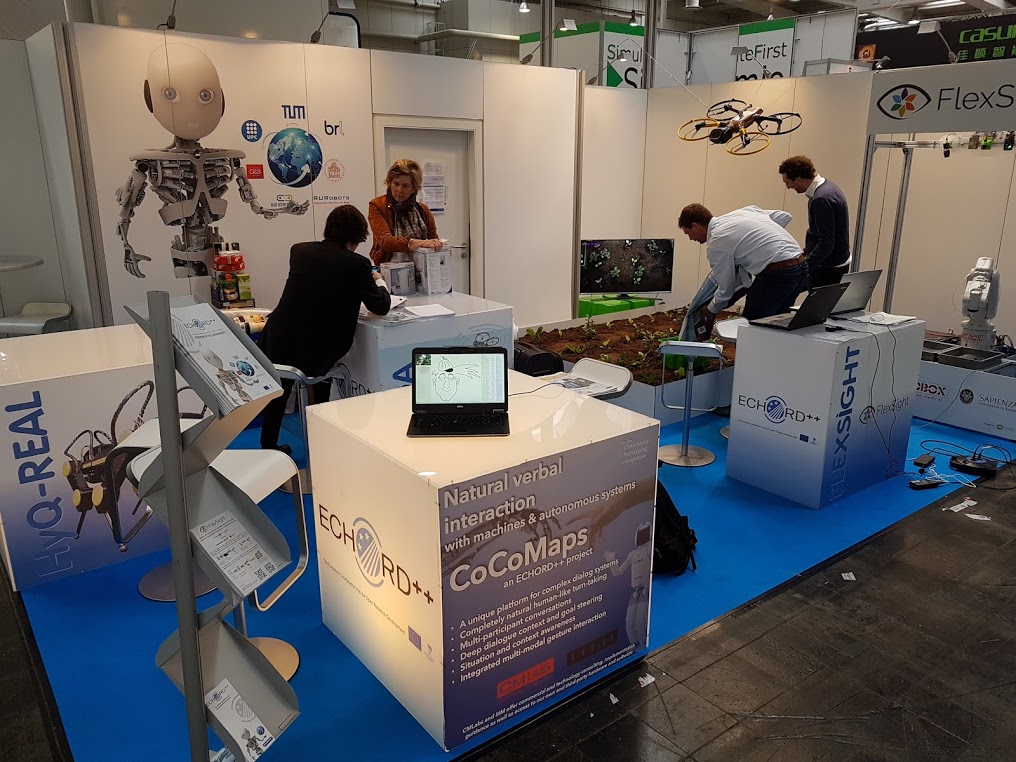
Under the EU’s ECHORD++ programme, CMLabs led Project CoCoMaps: real-time multi-party dialogue between two humans and two Honda ASIMO robots, coordinated through Psyclone. The system ran dozens of concurrent modules in mixed C++ and Python, handling speech, perception, turn-taking, and robot control simultaneously — with live demonstrations and published results across the project’s iterative phases. Research funding of this kind comes with external review; the results had to stand up in front of evaluators, not just in a lab notebook, and the architecture it validated is the same one shipping today. See the CoCoMaps archive →


Commercial and industrial deployments
Psyclone has been deployed by large Japanese automotive and robotics manufacturers, European robotics manufacturing plants, and an Israeli facial-recognition company running it in live commercial service — integrating computer vision, speech, real-time control, and distributed decision-making into systems that had to work in production, not just in a demo. These were paying deployments with real operational constraints: latency budgets, uptime expectations, and hardware that doesn’t forgive sloppy timing.



Platform hardening, continuously
A track record only matters if the platform is still moving. Psyclone’s engineering has continued well past its original research projects — including a recent stability pass across the core engine: race conditions eliminated, memory-safety fixes, a shared-memory corruption fix, and an expanded automated test suite with stall detection. For a real-time system, this is the unglamorous work that actually matters: deterministic behaviour under load, and failure modes that are detected rather than discovered. The platform keeps getting more crash-resistant, not just older.
⚙
Race conditions eliminated
🛡
Memory safety fixed
💾
Shared-memory integrity
📡
Stall detection added
Publications and technical documentation
Publications from the CoCoMaps project and the full Psyclone Platform System documentation are available for anyone who wants to look under the hood rather than take our word for it.
Seen enough track record?
See what the platform can do for your system → Services · or read how it works → Technology