Native GenAI: Amazon Bedrock & Google Gemini
Psyclone modules can now drive Amazon Bedrock and Google Gemini directly — bringing native, low-latency generative-AI inference into the real-time pub/sub fabric for building sub-second AI applications.


Psyclone modules can now drive Amazon Bedrock and Google Gemini directly — bringing native, low-latency generative-AI inference into the real-time pub/sub fabric for building sub-second AI applications.

Almost every real-time pipeline eventually needs to wait for a combination of things. Fuse three sensors before you act. Wait until both the transcript and the speaker ID have landed. Proceed once any two of five nodes report ready. Classic publish/subscribe gives you one trigger per message, so that logic has always ended up inside…

By keeping sockets non-blocking instead of flipping mode around every send (which cost four syscalls per message and raced the receive thread), TCP throughput more than doubled — from ~42k to ~90k msg/s — and per-message latency roughly halved, from 23.8us to ~11us.

Psyclone and its CMSDK core now build, run, and pass the full test suite as a first-class citizen on Apple Silicon and Intel macOS — joining Linux and Windows. The entire distributed pub/sub platform, from shared-memory messaging to the PsyProbe web monitor, is now developed and validated natively on Mac hardware.

A ground-up CMSDK test framework: one PASS/FAIL line per object, per-test process isolation with timeouts (a crash in one test can’t take down the suite), self-healing shared-memory cleanup, and timestamped performance JSON with %-deltas for automated regression detection. 33 tests, all passing.
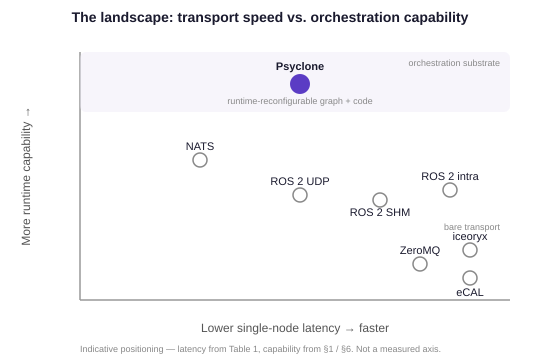
A rigorous single-node latency benchmark of Psyclone AIOS against NATS, ROS 2, iceoryx, eCAL and ZeroMQ – competitive default speed, the tightest tails measured, and the runtime-reconfiguration capabilities that set it apart.
Later this year we plan to release version 2.0 of the Psyclone platform. It is a complete rewrite of Psyclone 1.5 with all the old features intact and with massive performance improvements, merging of discrete and streaming data messaging, introduction of drumbeat signals for simulations and a completely new web interface, PsyProbe 2.0. You can…