“Did it hear me?” The uncanny valley of timing
In 1970 the roboticist Masahiro Mori described the uncanny valley: as a robot becomes more human-like we like it more — until it gets almost human, at which point small flaws suddenly feel deeply wrong.
Voice agents have walked straight into a version of this valley, and it isn’t about faces. It’s about timing. Today’s synthetic voices are warm, fluent and nearly indistinguishable from people. That raises our expectations of everything else — and the moment the timing is off, the illusion breaks harder than it ever did with an obviously robotic voice.
Timing carries meaning, whether you intend it or not
People do not hear a pause as “no data”. They hear it as a message.
Conversation researchers have measured this precisely. Kendrick and Torreira (2015) found that once the gap before a response reaches around 700 ms, listeners start to expect bad news — a refusal, a disagreement, a “well, actually…”. Roberts and Francis (2013) played people identical recorded “yes” answers to requests, changing only the silence before them: perceived willingness began to drop at around 600 ms and fell significantly between 700 and 800 ms — even though the answer was yes.
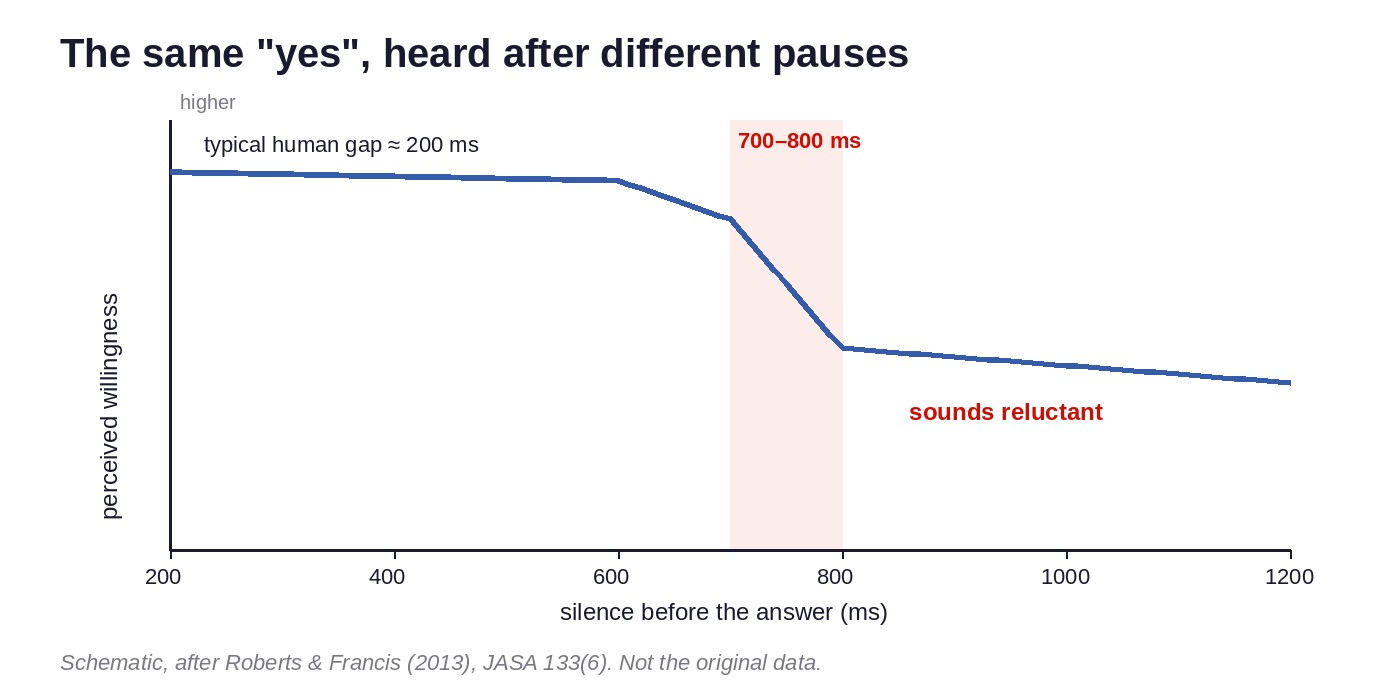
So a voice agent that pauses for a second before agreeing to book your table has, in human terms, just sounded reluctant. It didn’t mean to. It was waiting for a model. But the listener’s brain has already drawn a conclusion.
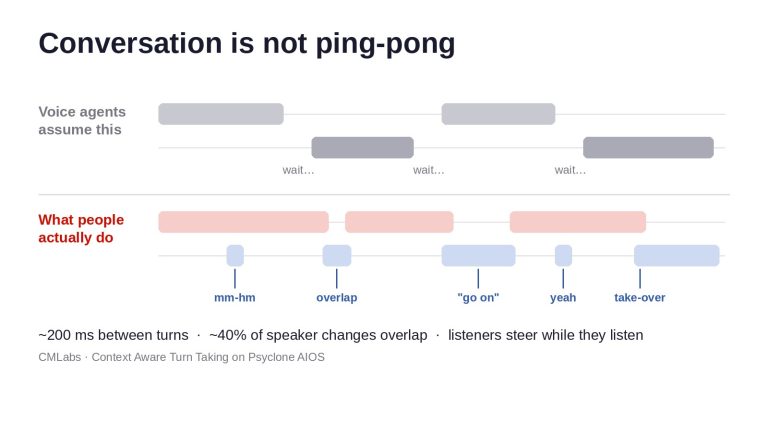
Too slow feels broken. Too fast feels like it isn’t listening.
The obvious fix is “make it faster”, and speed matters. But faster alone has its own failure mode.
An agent that replies the instant you stop — or before you have quite finished — signals that it wasn’t really listening, it was just waiting for its turn. An agent that answers a hard, emotional or complicated question in 150 ms sounds glib. People slow down before difficult answers; an agent that never does feels mechanical in a different way.
What people want is not minimum latency. It’s appropriate timing: fast acknowledgement, a response timed to fit what was asked, and visible effort when effort is genuinely needed.
The worst case: long silence on a big task
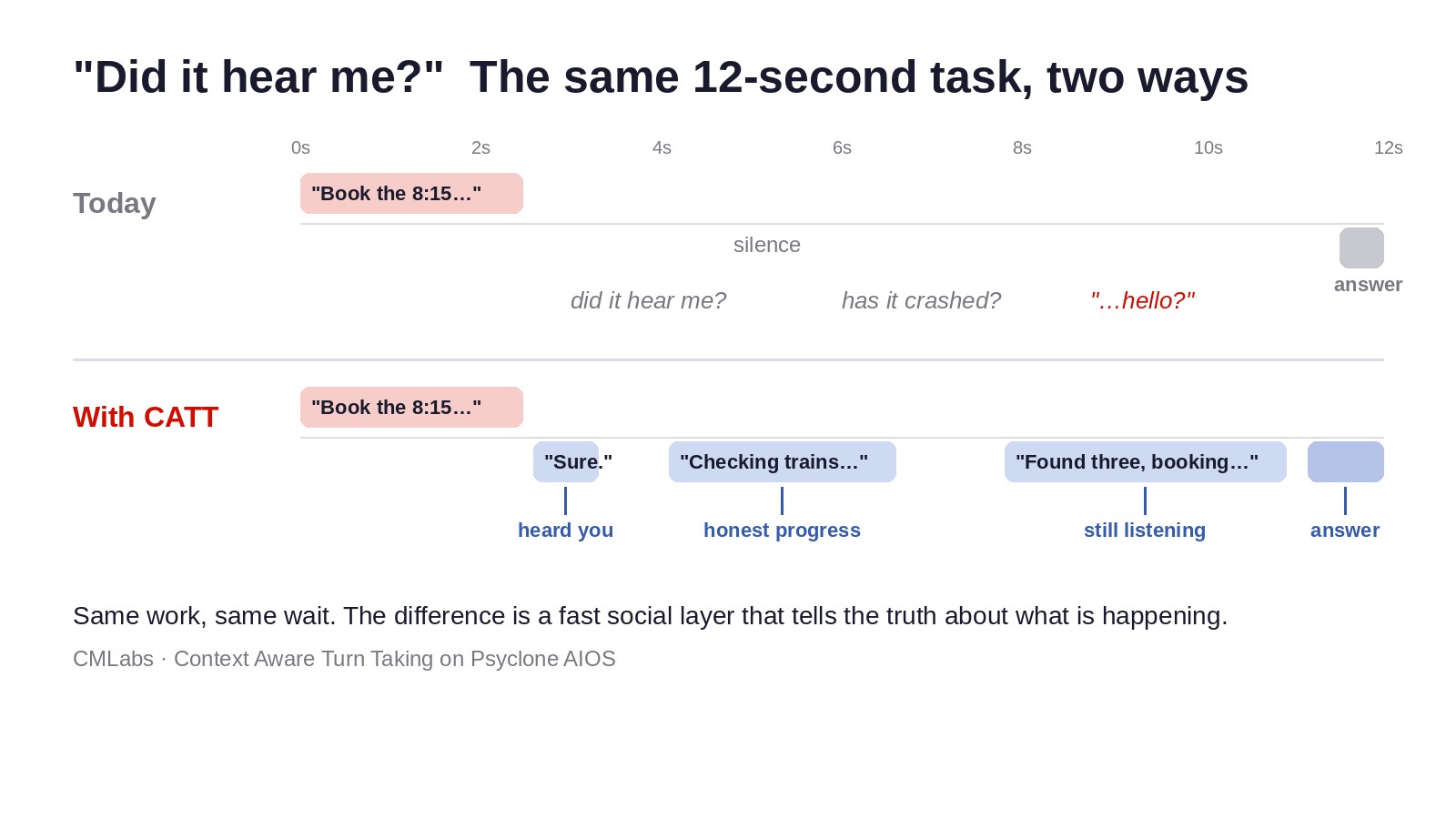
Now take the situation Part 1 flagged as one of the biggest problems in practice. You ask the agent to do something real: “find me the cheapest train to London tomorrow morning and book a seat”. That might take ten, twenty, thirty seconds of tool calls.
What happens in most agents today is silence. And silence, as we’ve just seen, is not neutral. Within a second you’re wondering whether it heard you. Within five you’re wondering whether it crashed. By ten you’ve said “hello?” — which the agent may now treat as an interruption, cancelling the work it was doing.
Even well-engineered systems face the arithmetic here. In our own reference system running on Psyclone we cut end-to-end response time from 11.7 s to 4.5 s — a big engineering win — and 4.5 seconds is still more than six times the point at which people start reading meaning into a pause. For genuinely big tasks, no amount of optimisation gets the answer under a second. Something else has to fill the gap.
Why canned fillers aren’t enough
The industry knows this. LiveKit, for example, offers a background-audio player that can play keyboard-typing “thinking” sounds automatically while an agent runs a tool or waits for its language model, and many products add a stock “one moment please”.
These help. But they are disconnected from what is actually going on:
- They don’t tell you whether you were heard — the most important question in the first second.
- They don’t tell you what is happening, or roughly how long it will take.
- They can’t be interrupted gracefully, or resumed sensibly when the real answer arrives halfway through a filler.
- And if they are generic, they become a tic. Hearing the same “let me check that for you” for the fifth time is its own small uncanny valley.
Linguists call the process of confirming mutual understanding grounding: people constantly signal “I got that”, “I’m on it”, “I’m still here”. It isn’t decoration. It’s how conversations stay synchronised.
System 1 and System 2, sharing one voice
Our approach in CATT borrows Daniel Kahneman’s distinction between fast, intuitive System 1 and slow, deliberate System 2 thinking.
In a system running on the Psyclone platform, the agent’s intelligence — the large language model, the tools, the memory — is System 2. It is powerful and slow, and it decides what to say.
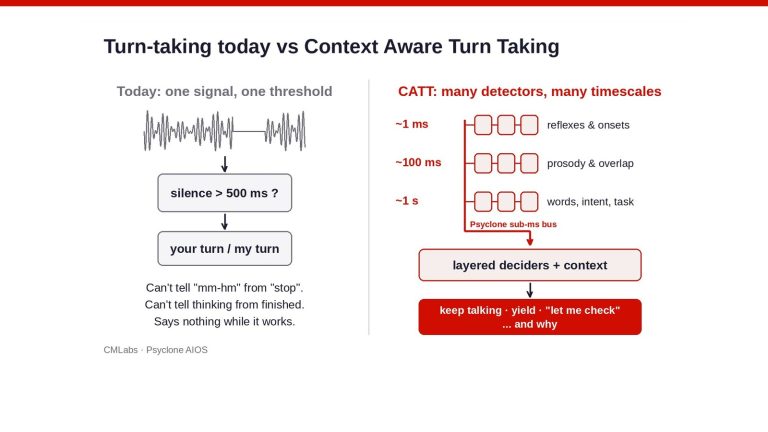
CATT adds a System 1 alongside it: a fast social layer that decides how and when to say things, in real time:
- Acknowledge immediately. A short, natural “sure” or “okay” within the human response window, so you know you were heard — before the slow part has even started.
- Make the effort visible, honestly. Progress cues tied to what the agent is actually doing (“checking trains now…”, “found three, comparing prices…”), not a loop of generic filler. If it isn’t checking, it doesn’t say it is.
- Keep the floor open. While a task is running, the agent is still listening — so “actually, make it Thursday” updates the task instead of cancelling it, and “mm-hm” doesn’t count as an interruption.
- Hand over cleanly. When the real answer arrives, the social layer finishes its current phrase rather than cutting itself off mid-word, then delivers it — and it knows exactly what the user has already heard, so nothing is repeated or skipped.
None of this is a script. It’s a set of small, fast decisions made continuously by detectors and deciders that know the state of the conversation and the state of the task — which is exactly the multi-timescale problem Part 2 described, and exactly what Psyclone is built to run.
A note on honesty
There is a line we don’t cross: making an agent seem human by pretending. Fillers that claim effort that isn’t happening, fake typing sounds when nothing is being typed, “um”s inserted to sound casual — these may help in a demo, but they erode trust the moment people notice. CATT’s social layer is designed to make the agent legible: you can always tell whether it heard you, whether it’s working, and when it’s ready.
Next
In Part 4 — The network is part of the conversation, we leave the lab: what we measured on real mobile networks — in cars, on trains, in crowds — and why an agent must never confuse “silence” with “no audio has arrived yet”.
References: Mori, M. (1970), “The uncanny valley”, Energy 7(4), 33–35 (English translation by MacDorman & Kageki, IEEE Robotics & Automation Magazine 19(2), 2012). Kendrick, K. H. & Torreira, F. (2015), “The timing and construction of preference: a quantitative study”, Discourse Processes 52(4), 255–289. Roberts, F. & Francis, A. L. (2013), “Identifying a temporal threshold of tolerance for silent gaps after requests”, Journal of the Acoustical Society of America 133(6), EL471–EL477. Clark, H. H. & Brennan, S. E. (1991), “Grounding in communication”, in Resnick, Levine & Teasley (eds.), Perspectives on Socially Shared Cognition, APA, 127–149. Kahneman, D. (2011), Thinking, Fast and Slow. LiveKit Agents documentation, “Background audio” (accessed November 2026).