Conversation is not ping-pong
Part 2 of 8 in our series on Context Aware Turn Taking (CATT): how we are building voice agents that converse like people, on the sub-millisecond Psyclone AIOS platform. Part 1: Why your voice agent stops mid-sentence
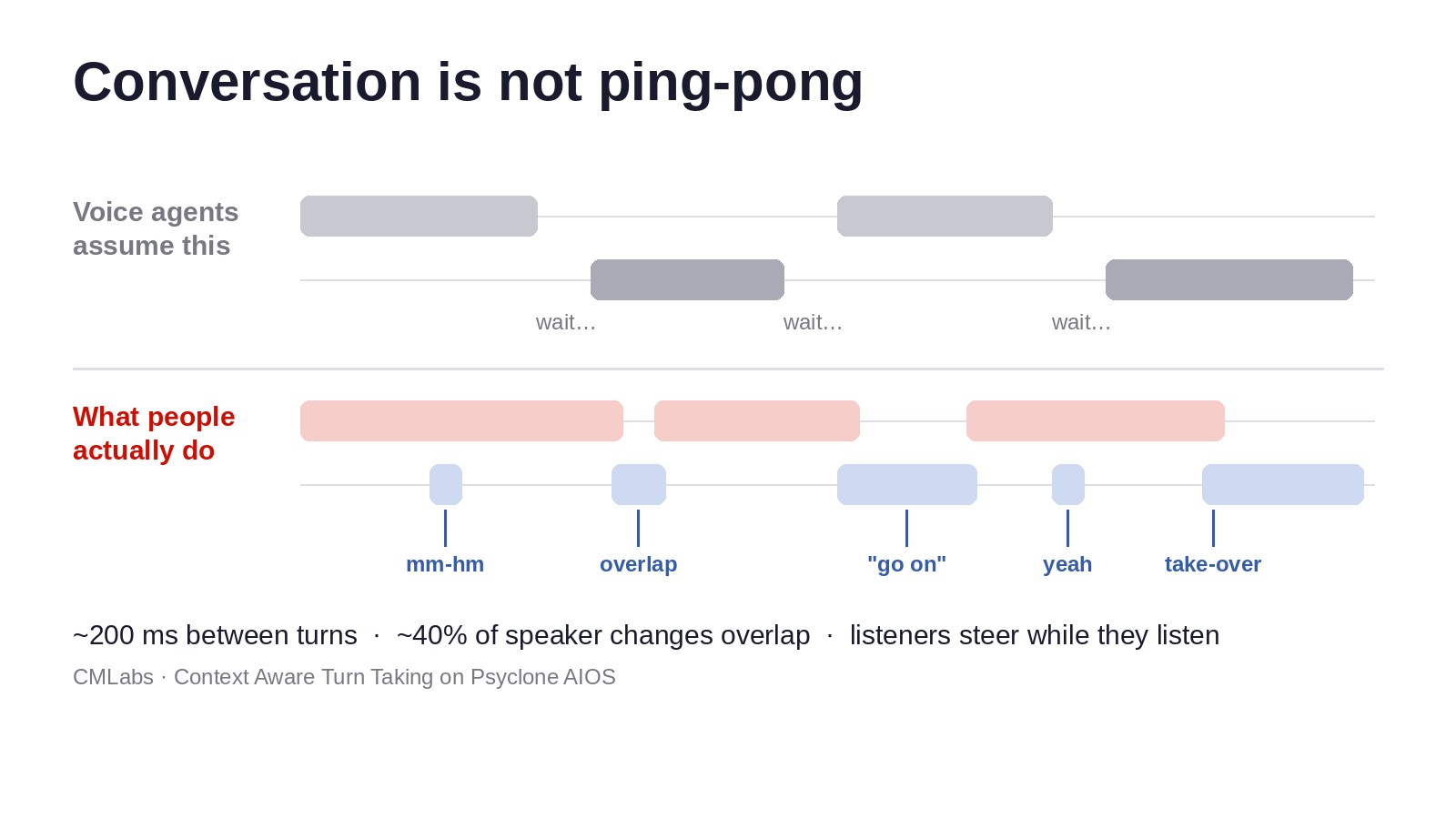
Most voice agents are built on a ping-pong model of conversation: you speak, you stop, the agent waits for silence, the agent speaks, it stops, you speak. Turns are tidy, sequential and separated by gaps.
Real conversation is nothing like that. It is fast, overlapping, collaborative and full of tiny signals that tell the other person how to behave. If we want agents that feel natural, we have to start from what people actually do — not from what is easy to detect.
People answer faster than they can think
The single most striking fact about human turn-taking is its speed. Across languages, the typical gap between one person stopping and the next starting is around 200 milliseconds. A ten-language study by Stivers and colleagues (2009) found average response times to yes/no questions ranging from about 7 ms in Japanese to about 470 ms in Danish, with the most common gap between 0 and 200 ms everywhere.
Yet psycholinguistics tells us that planning even a single word takes over 600 ms. As Levinson and Torreira (2015) point out, the only way both facts can be true is that listeners predict when the other person will finish and start preparing their reply while they are still listening.
That has a direct consequence for machines. An agent that waits until it is sure you have finished — by waiting for silence — will always be slower than a human, and will always feel slightly off. Humans do not react to the end of a turn. They anticipate it.
Overlap is normal, not rude
The second surprise: people talk over each other constantly, and mostly without any conflict. In conversation corpora, around 40 % of speaker changes involve some overlap, usually tiny — the most common overlap is under 50 ms (Heldner & Edlund, 2010). Gaps or overlaps shorter than about 120 ms are not even perceived as gaps or overlaps.
Classic conversation analysis — starting with Sacks, Schegloff and Jefferson’s 1974 account of how turn-taking is organised — showed that most overlap is orderly: the next speaker starts just as the current one is landing, or the listener slips in a short response without trying to take the floor.
So “the user is making sound while the agent talks” is not one event. It is a family of very different events.
The listener’s repertoire
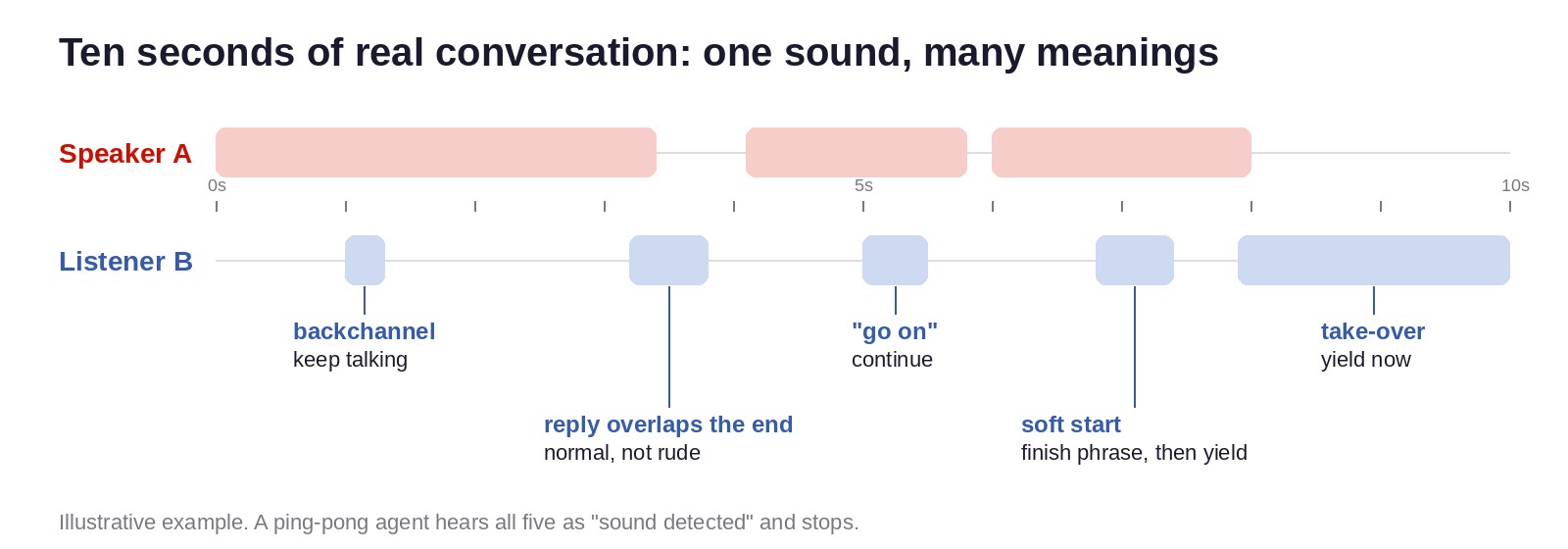
When you are listening to someone, you are not silent. You are steering. Here are some of the moves people make, and what a good speaker does in response:
- Backchannel — “mm-hm”, “yeah”, “right”. Meaning: I’m with you, carry on. Right response: keep talking, do not even pause.
- Agreement or assessment — “exactly”, “oh wow”. Meaning: I like that. Right response: keep going, maybe acknowledge.
- Urging on — “and?”, “go on”. Meaning: get to the point. Right response: continue, perhaps faster.
- Soft interruption — starting to say something without insisting. Right response: a speaker’s choice: finish the phrase, then yield; or pause and pick up again.
- Forceful take-over — sustained, louder speech with new content. Meaning: stop, it’s my turn. Right response: yield at once.
- Collaborative completion — finishing the speaker’s sentence for them. Right response: acknowledge and continue.
- Repair — “no, I meant Tuesday”. Right response: stop, drop what you were about to say, fix it.
And not everything is addressed to the agent at all: a cough, a laugh, a child in the back seat, someone talking on the next table.
A ping-pong agent sees all of these as the same thing — sound detected — and responds the same way: it stops. That is the false interruption from Part 1.
Pauses are just as varied
The same is true of silence. A pause can mean “I’m done”, “I’m thinking”, “I’m looking for the number”, “I’m waiting for you — you said you’d check my calendar”, or simply “the connection dropped” (more on that in Part 4). Each one calls for a different reaction: respond, wait, hold the turn open and show progress, or repair.
A silence timer cannot tell these apart, because they all sound identical. What separates them is everything around the silence: the melody of the last words, whether the sentence was grammatically complete, what the agent itself had promised to do, and how the conversation has gone so far.
Turn-taking is layered and multi-timescale
Thirty years ago, Kristinn R. Thórisson’s Ymir architecture (his 1996 MIT PhD, followed in 2002 by a chapter with the memorable title “Natural turn-taking needs no manual”) proposed treating turn-taking as many perception and decision processes running in parallel at different speeds: fast reactive loops in the tens of milliseconds, process-control decisions over hundreds of milliseconds, and content-level reasoning over seconds, all coordinating to produce fluid behaviour without a rigid script.
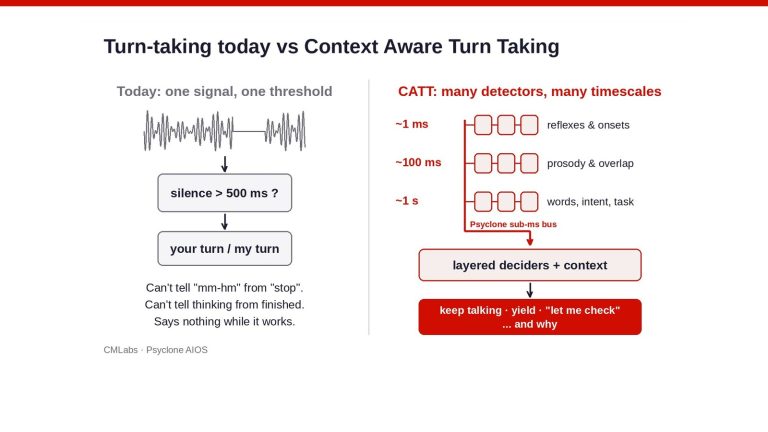
That is the idea CATT builds on. Instead of one question — has the user finished? — CATT asks many small questions continuously, each on its own timescale:
- Is that sound speech, and is it addressed to me? (milliseconds)
- Is this overlap a backchannel, an urge, or a take-over? (hundreds of milliseconds)
- Does this pause look like thinking, finishing, or waiting on me? (hundreds of milliseconds to a second)
- Given what we are doing right now — answering, searching, booking — what should the turn policy be? (seconds)
The answers are combined by layered deciders into one action — keep talking, yield, wait, say “let me check” — with a record of why. Context sits at the top: the same “yeah” means “carry on” in the middle of a long explanation and “yes, book it” at the end of a question.
Why this needs a different kind of runtime
Running dozens of small detectors in parallel, at timescales from sub-millisecond to seconds, and letting their conclusions flow up into decisions fast enough to act before the moment has passed, is a messaging and orchestration problem as much as an AI problem. Every hop between detectors costs time, and in a conversation, 200 ms is the whole budget.
That is why CATT runs on Psyclone AIOS, whose message bus moves data between modules in microseconds rather than milliseconds (see our benchmark report). Part 5 will look at how that architecture fits together.
Next
In Part 3 — “Did it hear me?” The uncanny valley of timing, we turn to the social side: why replying too fast can feel as wrong as replying too slowly, and how an agent can stay present during a long task without lying to you.
References: Sacks, Schegloff & Jefferson (1974), “A simplest systematics for the organization of turn-taking for conversation”, Language 50(4), 696–735. Stivers et al. (2009), “Universals and cultural variation in turn-taking in conversation”, PNAS 106(26), 10587–10592. Heldner & Edlund (2010), “Pauses, gaps and overlaps in conversations”, Journal of Phonetics 38(4), 555–568. Levinson & Torreira (2015), “Timing in turn-taking and its implications for processing models of language”, Frontiers in Psychology 6:731. Thórisson (1996), Communicative Humanoids: A Computational Model of Psychosocial Dialogue Skills, PhD thesis, MIT Media Lab. Thórisson (2002), “Natural turn-taking needs no manual: computational theory and model, from perception to action”, in Granström, House & Karlsson (eds.), Multimodality in Language and Speech Systems, Kluwer, 173–207.