CMLabs Technical Report · v2.2, July 2026 · one-page summary · ⬇ Download this one-pager (PDF) · full report PDF
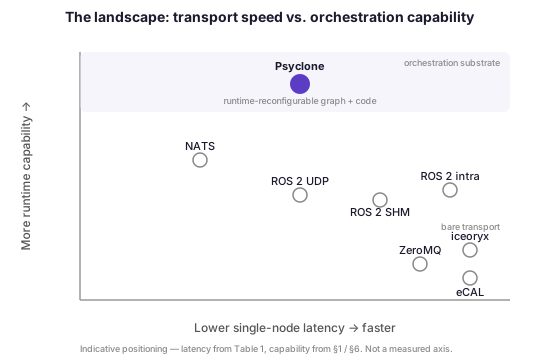
NATS — distributed broker; horizontal fan-out and durability, two socket hops per message on-node.
ROS 2 (Fast-DDS) — robotics middleware; measured in three regimes: default UDP, tuned SHM, and single-process intra-process.
Eclipse iceoryx — true zero-copy shared-memory transport; the fastest cross-process path measured.
eCAL — SHM pub/sub middleware; single-digit-µs class at small payloads.
ZeroMQ inproc — in-process library channel; no process isolation.
The last three are bare transports — no broker, no orchestration, no runtime-reconfigurable graph. They set the raw-latency floor Psyclone is read against.
| System (config) | 64 B p50 | 64 KB p50 | 64 KB p99.9 |
|---|---|---|---|
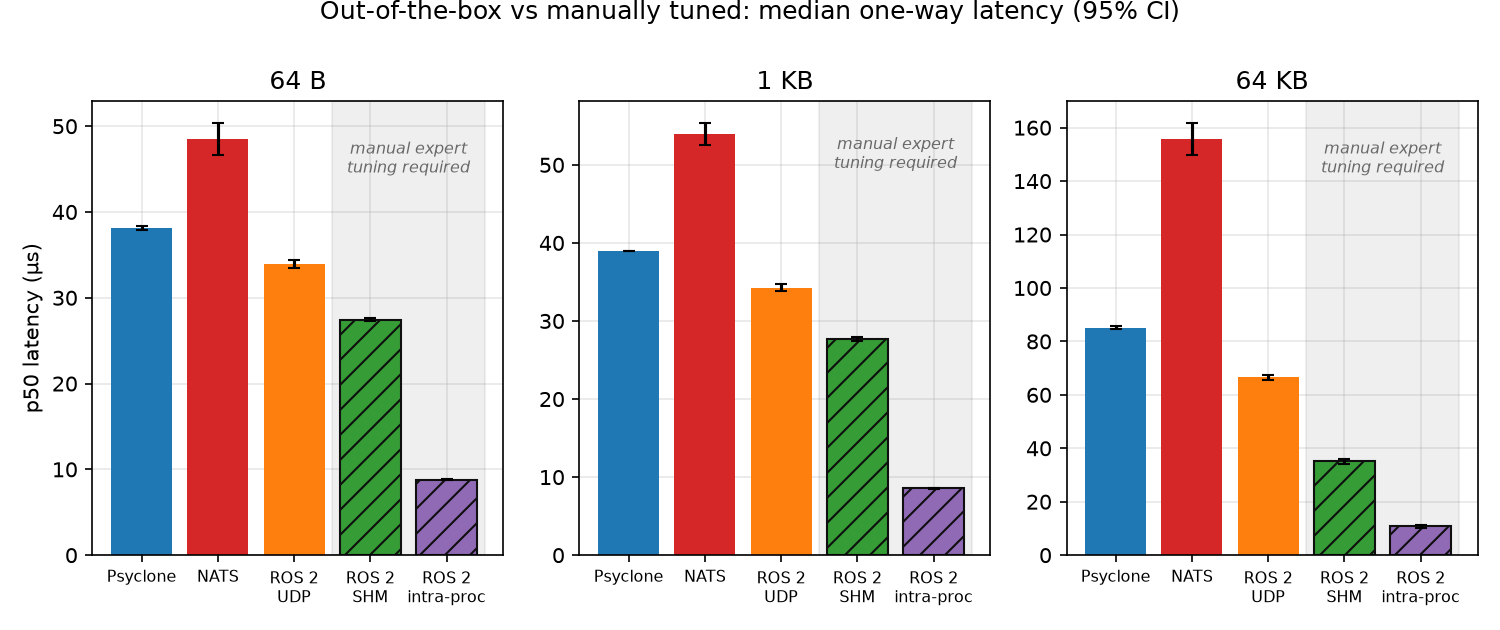
| iceoryx (zero-copy transport) | 6.2 µs | 12.3 µs | 16.3 µs |
| ROS 2 intra-process (tuned) | 8.8 µs | 10.9 µs | 16.1 µs |
| ROS 2 Fast-DDS UDP (default) | 33.9 µs | 66.6 µs | 87.7 µs |
| Psyclone (default install) | 38.1 µs | 85.1 µs | 124.0 µs |
| NATS (default) | 48.5 µs | 155.7 µs | 761.4 µs |
10 trials × N=100,000, mean ± 95% CI, CPU-pinned; validated on bare metal (z1d.metal). Psyclone's p99.9 stays within ≈1.8× of its median at every payload — the tightest, most predictable tails measured.
Methodology, all tables, bare-metal replication, cross-node estimates, and the differentiator measurements are in the full paper. AWS z1d.2xlarge & z1d.metal, kernel 7.0.0-1006-aws · NATS 2.14.3 · ROS 2 lyrical / Fast-DDS 9.4.8 · Psyclone AIOS 2.1.0 (LGPL v3).